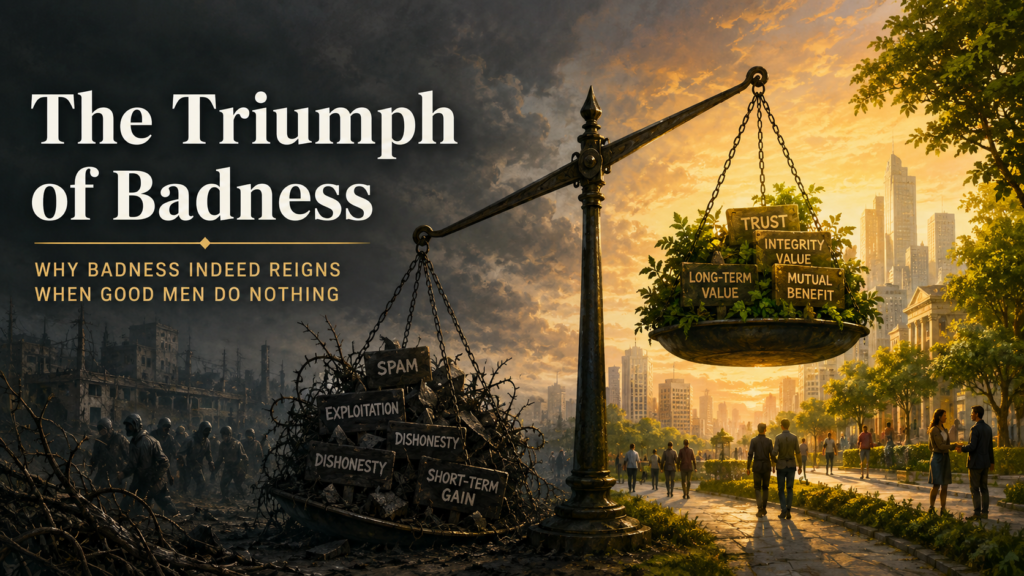
Why badness indeed reigns when good men do nothing
Bad money drives out good money, bad species drive out good species, and bad behavior drives out good behavior. In any situation where cheap, spamlike, or exploitative behavior goes unpunished, it spreads and eventually drives out its better counterpart.
In this article we will investigate the mechanism behind this phenomenon, and we will explain why every social system, be it a company, a club, a platform, or a society, must have efficient and effective countermeasures against all forms of abuse and exploitation, if it wishes to persist over time.
Note: The species example is more of an interesting parallel, and maybe also an apt metaphor, than a true example. It naturally relies on another mechanism, namely natural selection, and not human choices.
Introduction
This morning I came across a piece about how editors on Medium can now mass-ban low-effort writers. In the comment section an editor said that she herself literally gets flooded with weak submissions. She expressed her frustration about reading countless low-quality articles, and then, when she sometimes sent them a polite refusal or detailed corrections, she literally never heard back from them.
She suspected that they were just spamming low-quality articles to hundreds of publications, no matter if the topic truly fit or not. This misbehavior on Medium is one trivial example of a very deep problem that affects every social system: People can often get a competitive advantage by violating ethical norms and behavioral expectations.
The Mechanism
The phenomenon we are talking about here is known to economists as the tragedy of the commons. It originally got its name from the commons, meaning the shared pasture lands that all members of a community used collectively to graze their cattle. In this setting, each individual member has a rational incentive to graze as many animals as possible, but if all together graze too many animals, they destroy the commons, thus leaving everyone poorer.
The problem is not that the farmers are evil or psychopathic. The problem is simply that each individual farmer benefits directly from grazing one animal more, while the cost of this behavior is shared across everyone and only arrives later.
The incentives therefore drive individuals to overuse the commons, leading to its eventual destruction. And even if the pasture is actively being ruined at that very moment, the incentives still push each farmer towards overgrazing it further, because like this he will still get the most out of what remains before the commons are entirely ruined.
Some Examples
Once you have understood this dynamic, you cannot help but see it everywhere, such as in the monetary system, in biology, and naturally also in ethics.
“Bad money drives out good money”, say the economists. Bad currency (like paper money, debt notes, or treasury bills) is cheaper to produce and less worth holding on to than good money (like Gold, Bitcoin, etc.). So more and more bad currency gets created and circulated, and in the end the bad currency drives the good currency out of use and thus becomes the standard of payment.
Next, consider Biology: Species that reproduce quickly and cheaply can crowd out more advanced and complex ones. Higher species often breed more slowly and each individual requires more upfront investment. Thus, if they cannot fight back against the smaller pests, the latter will eat away all the food from under their noses, and the more complex species will die out.
Third, consider sexual behavior. Both men and women have a societally desirable and a societally destructive mating strategy.
The desirable strategy is to form stable, mutually beneficial long-term relationships, as these are most conducive to productive work, raising children, and perhaps even leaving some time and energy for participation in civic life.
The destructive strategy is to trade money, power, or feigned interest for sex, or to trade sex for money, power, or attention, depending on which side one comes from. Both behaviors are destructive because they incentivize members of the opposite sex to abandon the stable and long-term beneficial pattern.
They also both undermine their positive counterpart. If enough women give men sex too easily, then good women are pressed to follow suit, and if enough men shower women with unearned attention and money in order to get sex quickly, then this too comes to be expected by all women. In both cases, the bad behavior of some makes life harder for the remaining good actors.
Other examples come from the professional life. Manipulation, dishonesty, self-aggrandizement, and the willingness to take false credit and deflect blame all benefit the individual. Thus if bad actors are left unchecked, they advance faster and earn more, and acting ethically becomes a fool’s errand. Because the rewards for ethical behavior only ever materialize, when enough other people exhibit it too, and this is now no longer the case.
The more ambitious people thus copy the unethical behavior, even if they personally dislike it, and others disengage, stop trying, stop trusting. Again, the bad behavior drives out the good one, and in the end all members of society are worse off for it.
The Necessity of Correction
We see from all of these examples that values too are a common good. As long as enough people maintain them, everyone benefits. Relationships are stable and mutually beneficial, there is less internal strife, things work better, and more goods and services are being produced. But each individual actor is incentivized to violate them, and the cost of doing so is spread across all others and only ever materializes in the future.
Thus good values are very similar to the common pastures, in that everyone has an individual incentive to cut some corners, but as soon as enough people cut enough corners, the whole structure collapses and everyone is worse off for it.
It thus does not matter if even the majority of a group does not wish for this development, as long as bad behavior is not checked, the values of a society will still degenerate, because each individual actor adapts to his environment. The only way a group can protect its values is thus to punish misbehavior and to ban bad actors, i.e. to render bad behavior unprofitable.
It is important to note, that the above described mechanism of deterioration shows a strong threshold effect. When all behave well, one bad actor is easily spotted and punished or removed. But once a certain bad behavior has become common enough, it becomes almost impossible to eradicate. People now simply expect it, and even though they may lament this fact, no one quite knows how to get rid of it again.
Thus once the quality of a social group has deteriorated enough, it is oftentimes easier to just start anew, rather than trying to turn the ship around and starting to create incentives for long-term, mutually beneficial behavior in an environment full of predators, freeloaders, and parasites. The good actors thus quietly leave, and the system deteriorates until it is finally no longer worth participating in for anyone. This is why bad companies go bankrupt, bad platforms lose their users, bad clubs dissolve, and bad societies collapse.
Thus every social system must actively maintain certain standards of behavior if it wishes to persist, and for this it needs mechanisms to punish bad behavior and exclude bad actors. This is true for societies, companies, marketplaces, and also for platforms such as Medium.